

Freemasoninformation.com
http://www.freemasoninformation.com/esoterica/holysaintsjohn.html
The Holy Saints John, Duality in the Construct of One
By Br. Gregory Stewart, Los Angeles, California, USA
"A Traveler in Freemasonry"
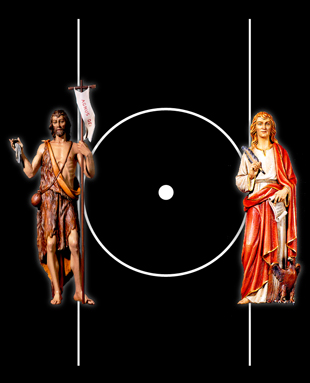
The Saint’s, John the Baptist and John the Evangelist, appear to Freemasons in several places in our catechisms. Their proximity and use in our rituals have been questioned for many years as to their use and placement. Looked at together, saint John the Baptist and St. John the Evangelist serve to represent the balance in Masonry between zeal for the fraternity and learned equilibrium. The Saints John, stand in perfect parallel harmony representing that balance.
From a historical approach, The Saint John’s festival is said to be a widely celebrated Masonic holiday. Traditionally June 24th (or the summer Solstice) is taken to be John the Baptist’s day, which is celebrated in many cultures around the world. According to McCoy’s Masonic Dictionary, the Festival of St. John in summer is a duty of every Mason to participate in, and should serve to be a renewal and strengthening of fraternal ties and a celebration of Masonry from “olden-times”. It functions as a connection between the past and the future.
The festival, to non-Masons, has been called the “Setting of the Watch”, where ceremonial bonfires were lit after sunset. Tradition says that men, women, and children would jump through the fires for luck. Across Europe, this holiday is celebrated in many ways. With oak wreath crowns, wild flowers and birch branches. Families would feast and celebrate in union. The meanings of these ancient traditions are lost today on our society, but the link was made at some point to John the Baptist. The On-line Catholic Encyclopedia points to the birth of John the Baptist as 6 months before Christ, placing him on the summer solstice. It is thought that these festivals have been linked in character and content with the birth of John the Baptist.
From the Masonic perspective we are given the balanced dualism of John the Baptist on one side and John the Evangelist on the other. Represented together this way represent the balance of passionate zeal with and learned knowledge of faith forming a space to reflect on to and channel our passion as well as our education/knowledge. Individually strong, together they stand as a harnessed focus of zeal and knowledge. This counterpoint is not just necessary to Freemasonry but can be applied to all areas of life. Taken as an abstract compilation of symbols, together they represent a well-balanced path towards enlightenment.
The two dualistic figures as one, the Holy Saints John, balance each other in the Masonic year, but also in other areas too. One unique aspect that I found is in the application of the Alchemical symbols of fire and water. Alchemy has long been thought of as an early component of Freemasonry and using the alchemical symbols here may help the representations of the Saint John’s look more familiar. Saint John the Baptist, represented as the inverted pyramid, the Alchemical sign for water, representing the spiritual and emotional love. St. John the Evangelist, represented as the pyramid pointing up symbolizing fire that is the drive and will of action. When placed together, they symbolize the perfect balance of darkness and light, life and death, passion and constraint, will and emotion, winter and summer. Together both represent the interlocked star of Solomon, or the Square and Compass. This is an entirely open analysis, and made for the purposes of comparison, but it does offer a unique analysis of the juxtaposition of the Holy Saints John.
In looking toward the future, St. John the Baptist Day is an appropriate celebratory day for Freemasons, as it is a good day to come together and reflect in out past and in our future. It stands to remind us, not just of our past, but also of a recommitment of our circumscribed passions. In all of our time they’re as a fraternity, union celebrations such as this one help us to reaffirm our ties that bind. Whether those ties be the bindings of fraternity or the familiarity of institution, we should remember the Holy Saints John’s, not just in our sacred Jerusalem’s but together in brotherhood.
SAINTS JOHN, SOLSTICES AND FREEMASONRY
by Leon Zeldis FPS
In many countries, Freemasons follow an ancient tradition and celebrate twice a year the so-called Solsticial Feasts, also known as Festivities of St. John, the Evangelist in December and the Baptist in June.
As is well known, the inclination of the earths axis in relation with the plane of its orbit around the sun originates an apparent upward and downward movement of the sun. That is, during six months the sun rises and sets at points on the horizon a little to the south of those of the previous day, while in the other six months of the year, the movement is reversed and the sun slowly ascends toward the north. This is the cause for the changing seasons. The dates when the sun stops moving in one direction and reverses its apparent course are called solstices (from the Latin for sun and stop). The winter solstice, in the northern hemisphere, falls between December 21 and 22, and marks the suns lowest point above the horizon. It is as if the sun was approaching death, and in many cultures special ceremonies were performed, destined to prevent the continued descent of the sun, ensuring its rebirth, that is, the beginning of its northward journey. To this effect, fires of different kinds were lit, sometimes accompanied by human sacrifices. Possibly the Jewish ?feast of lights?, Hanukah, held in December, as well as the lights on the Christmas tree, have their origin in ceremonies of this kind.
Freemasons, however, do not celebrate solstices for astronomical reasons, nor in remembrance of a pagan rite. Our purpose is both more elevated and more involved. It is important to understand it, for in these celebrations much of Masonic philosophy is expressed.
The invariable course of the planets in heaven, the eternal cycle of yearly solstices and equinoxes (annus, the year in Latin, is related to the word for circle or ring, the anulus), constitute the most striking demonstration of the order that reigns in Nature.
This order, however, must reflect an act of creation. Ordo ab Chao. In other words, the act of creation itself is a process of introducing order. The Book of Genesis makes this very clear, God separates light from darkness, water from water (sky and earth), the day from the night.
Let me add a few more examples to expand on this concept. Let us imagine an artist, holding a palette with all the colors he intends to use. All the colors are there. But as long as the painter does not impose a certain order, placing dab after dab of color upon the canvas, the colors remain an incoherent collection of pugments. Only owing to the order imposed by the artist is the work of art born.
Take another example. Should we imagine an orchestra, the best in the world, where we instruct the musicians to play each according to his hearts content, what would be the result? An intolerable cacophony! Only through the order established by the composer and interpreted by the conductor and the players, are the sounds of the instruments transformed into music.
The genetic code of the human species has been deciphered. The Human Genome has been published, with all its 30 or 40 thousand genes. All that makes us human, from the color of the eyes, hair and skin to height, intelligence and inherited diseases, all of them are determined by the order of four basic elements arranged along the double helix of the DNA: adenine, guanine, cytosine and thymine. I repeat, the chemical composition of the genetic code is invariable, only the order of these four bases introduces all the enormous differences between one individual and another.
A last example, our English alphabet is composed of 26 letters. Other alphabets have a few more letters, or a few less. The point is, with less than thirty graphic signs we can represent all of world literature, philosophy and history. What distinguishes one idea from another, one word from the others, is simply the order in which the letters are placed.
Order, then, lies at the base of reason, logic, all sciences, al creation. That is why we represent the divinity in our Order (note the name!) as the Great Architect of the Universe. The great builder who introduces order in place of chaos. Disorder is the law of madness. A disordered mind is the antithesis of reason.
Let us return for a moment to the alphabet. Assume that all of Shakespeares works comprise a million letters. It makes no difference for our example if the number is not accurate. Assume, also, that we have a computer program that selects letters and spaces at random and sends them to the printer. According to the laws of probability, at a certain point the computer would print the entire works of Shakespeare in the right order. Fine, but any reader who has elementary knowledge of statistics will appreciate at once that the number of permutations involved is so huge that e have no way of expressing the time required to perform them. 1
Random combinations, then, could not have produced Shakespeares works. The work of one writer, a few books among the many thousands or millions that have been written. What shall we say, then, of the permutations required for designing a cell, a living organism, a human being? How many aleatory - chance - combinations would result in the atoms and molecules that compose the millions upon millions of galaxies and stars dispersed in the universe? Is that really a rational hypothesis?
In my opinion, order in the universe is the irrefutable evidence that a superior reason does exist, inscrutable for us, which we designate the Great Architect. That is why we celebrate the solstices, in homage to the immutable order of nature that reminds us, day after day, year after year, that our lives must not be left to the rule of chance, the law of madness, but to that of order, reason, the logic of mathematics, the queen of sciences, represented in our Temples by the letter G placed in the center of the Lodge.
Everything else in our institution arises from that fundamental premise. Tolerance, fraternity, equality, are but partial aspects of the inevitable conclusion that a well-formed soul must draw before the stupendous spectacle of a world ruled by order.
Order is the mark of the Mason. Order in his manner of standing, walking, speaking, in the course of the ritual. Do we not say that a Lodge is regular when it is truly Masonic? Regular means following a rule, an order.
Order, moreover, implies something else. It implies an objective, an end. The work of art if born when the artist orders the colors in order to achieve a certain result. Words are ordered by the writer or the poet to express his ideas.
If all creation implies introducing order, and all ordering implies an objective, our world is not a theatre of the absurd, but the expression of an intention, an objective which we may be unable to conceive or explain, but which must necessarily exist because of the very fact that the world is in order and not in chaos.
For those who are curious, taking a space as an additional character, the number of permutations would be 27 raised to the millionth power: 271,000,000.


