


When stone mouldings, cills, string-courses, etc., are continued around an angle, the point where they change direction must not coincide with the joint because an acutely angled piece of stone is subject to damage and easily snapped off. The joint, therefore, is formed at right angles to the naked of the wall at a distance from the angle, the change of direction of the moulding effected by cutting it to shape. See reprise.
Masons Mitre Description
www.answers.com

"We control the seminaries, the academic departments of theology, the catechetical and liturgical institutions, the publishing houses, the magazines that matter and the chanceries. Most of the bishops are now on our side and those that aren't have been neutralised. Anybody who wants a future in the hierarchy or the Catholic academy has no choice but to co-operate."
- 'Father' Hans Kung


CatholicCitizens.org - Catholic Citizens of Illinois
http://www.catholiccitizens.org/press/contentview.asp?c=40493
LONG TIME COMING: Exiled Theologian Hans Kueng Earns "Culture Award of German Freemasons" For a Lifetime of Service to 'the Craft'
5/20/2007

Hans Kueng: Giving the Devil his due
Wikipedia Entry Hans Kueng In 1960 Küng was appointed professor of theology at Eberhard Karls University, Tübingen, Germany. Just like his colleague Joseph Ratzinger (now Pope Benedict XVI), in 1962 he was appointed peritus by Pope John XXIII, serving as an expert theological advisor to members of the Second Vatican Council until its conclusion in 1965. At Küng's instigation, the Catholic Faculty at Tübingen appointed Ratzinger as professor of dogmatics. However, due to the 1968 students revolt, Ratzinger moved to the university of Regensburg, ending the cooperation between the two. In the late 1960s Küng became the first major Roman Catholic theologian after the late 19th century Old Catholic Church schism to reject the doctrine of papal infallibility, in particular in his book Infallible? An Inquiry (1971). Consequently, on December 18, 1979, he was stripped of his license to teach as a Roman Catholic theologian but carried on teaching as a tenured professor of ecumenical theology at the University of Tübingen until his retirement (Emeritierung) in 1996. To this day he remains a persistent critic of papal authority, which he claims is man-made (and thus reversible) rather than instituted by God. He was not excommunicated and remains a Roman Catholic priest. In the early 1990s Küng initiated a project called Weltethos (Global Ethic), which is an attempt at describing what the world religions have in common (rather than what separates them) and at drawing up a minimal code of rules of behaviour everyone can accept. His vision of a global ethic was embodied in the document for which he wrote the initial draft, Towards a Global Ethic: An Initial Declaration. This Declaration was signed at the 1993 Parliament of the World's Religions by many religious and spiritual leaders from around the world. Later Küng's project would culminate into the UN's Dialogue Among Civilizations to which Küng was assigned as one of 19 "eminent persons." Even though it was completed shortly after the terrorist attacks of 9/11 (in November 2001), there was no coverage in the U.S. media, something about which Küng complained.
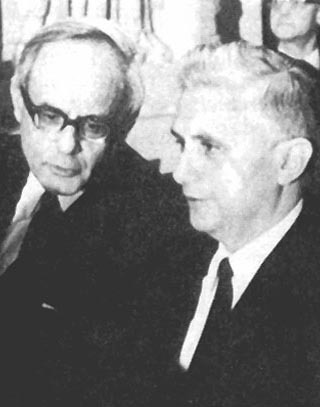
1962 Vatican II. Dressed in a secular suit and tie instead of a Priests Clerical clothing Fr. Joseph Ratzinger receives orientation from his mentor,
progressivist theologian Karl Rahner SJ.
Wikipedia Entry Pope Benedict Academic Career
Ratzinger became a professor at the University of Bonn in 1959; his inaugural lecture was on "The God of Faith and the God of Philosophy." In 1963, he moved to the University of Münster, where his inaugural lecture was given in a packed lecture hall, as he was already well known as a theologian[citation needed].
During this period, Ratzinger participated in the Second Vatican Council (1962–1965). Ratzinger served as a peritus (theological consultant) to Josef Cardinal Frings of Cologne. He was viewed during the time of the Council as a reformer, cooperating with radical Modernist theologians like Hans Küng and Edward Schillebeeckx. Ratzinger became an admirer of Karl Rahner, a well-known academic theologian of the Nouvelle Théologie and a proponent of church reform.
In 1966, Joseph Ratzinger was appointed to a chair in dogmatic theology at the University of Tübingen, where he was a colleague of Hans Küng. In his 1968 book Introduction to Christianity, he wrote that the pope has a duty to hear differing voices within the Church before making a decision, and he downplayed the centrality of the papacy. He also wrote that the Church of the time was too centralized, rule-bound and overly controlled from Rome[citation needed]. During this time, he distanced himself from the atmosphere of Tübingen and the Marxist leanings of the student movement of the 1960s that quickly radicalized, in the years 1967 and 1968, culminating in a series of disturbances and riots in April and May 1968. Ratzinger came increasingly to see these and associated developments (such as decreasing respect for authority among his students) as connected to a departure from traditional Catholic teachings.[10] Despite his reformist bent, his views increasingly came to contrast with the liberal ideas gaining currency in theological circles.[11]
Some voices, among them Hans Küng, deem this a turn towards Conservatism, while Ratzinger himself said in a 1993 interview, "I see no break in my views as a theologian [over the years]".[12] Ratzinger has continued to defend the Council against criticism, including Nostra Aetate, the document on respect of other religions, ecumenism and the declaration of the right to freedom of religion. (Later, as the Prefect for the Congregation for the Doctrine of the Faith, Ratzinger most clearly spelled out the Catholic Church's position on other religions in the 2000 document Dominus Iesus which also talks about the Roman Catholic way to engage in ecumenical dialogue.)
During his years at Tübingen University, Ratzinger publicized articles in the reformist theological journal Concilium, though he increasingly chose less reformist themes than other contributors to the magazine such as Hans Küng and Edward Schillebeeckx.
Wikipedia Entry Pope Benedict Atire
One item that Benedict has not worn to date is the papal tiara. Like his two immediate predecessors, Benedict chose not to be crowned with the tiara during his Inauguration Mass, nor has he worn it since that time. Unlike them, however, he has emphasized this decision by breaking with prior tradition in using a mitre instead of the tiara in his coat of arms. Other traditional pontifical vestments remain unused as well, including the fanon, the pontifical gloves, and the papal slippers.
-EWTN Benedict XVI's Coat of Arms
The coat of arms of Pope Benedict XVI incorporates both papal elements, as well as the elements of the coat of arms he bore as Archbishop of München (Munich) and Freising, and as the Prefect of the Congregation for the Doctrine of the Faith.
Miter. The miter replaces the "beehive" tiara familiar from former papal coats of arms. Pope Paul VI dropped the ceremonial use of the tiara, although he, and his immediate successors John Paul I and John Paul II, retained it in their coats of arms. Benedict XVI has replaced it with the miter, on which is emblazoned three gold bands representing "order, jurisdiction and magisterium."
These are the symbolic equivalents of the three layers of the tiara. They are connected into a unity by the vertical gold strip, representing the unity of these three kinds of authority in the person of the Supreme Pontiff.
Pallium. The use of the white pallium with red crosses draped below the shield is a new addition to papal coats of arms. It represents episcopal authority, the special kind of jurisdiction that is reserved to metropolitan archbishops in their province and to the pope universally in the Church, what is called the plenitudo pontificalis officii (i.e. the plenitude of pontifical office). The style of pallium shown on the coat of arms, with either red or black crosses on a narrow band of wool, is what is commonly known from the second millennium. At his inaugural Mass, Pope Benedict wore an older style of pallium, broad with red crosses, and hanging down from the left shoulder rather than in the middle. This style is more typical of the first millennium, and similar to the omophorion representing episcopal authority in the Eastern Church.
Crossed Keys. The two crossed keys symbolize the powers Christ gave to the Apostle Peter and to his successors.
I will give you the keys to the kingdom of heaven. Whatever you bind on earth shall be bound in heaven; and whatever you loose on earth shall be loosed in heaven." (Matthew 16:19)
The gold key represents the power to bind in heaven and the silver key spiritual authority on earth. The two keys are united by the cord, again indicating their essential unity in Peter and his successors.
Caput Aethiopum. According to the website of his former Archdiocese:
"The shield, which is divided into three sections, displays the “Moor of Freising." The Moor’s head, facing left and typically crowned, appeared on the coat of arms of the old principality of Freising as early as 1316, during the reign of the Bishop of Freising, Prince Konrad III, and it remained almost unchanged until the “secularization” of the Church’s estates in that region in 1802-1803. Ever since that time the archbishops of Munich and Freising have included the Caput Aethiopum, the head of an Ethiopian, in their episcopal coat of arms."
Bear of Corbinian. Also present on the coat of arms is a bear with a pack-saddle, the so-called “Bear of Corbinian." The saintly Bishop Corbinian preached the Christian faith in the Duchy of Bavaria in the 8th century and is considered the spiritual father and patron of the archdiocese. A legend states that he traveled to Rome with a bear as his pack-animal, after having commanded it to do so. Once he arrived, he released the bear from his service, and it returned to Bavaria. The implication is that "Christianity tamed and domesticated the ferocity of paganism and thus laid the foundations for a great civilization in the Duchy of Bavaria." At the same time, Corbinian’s Bear, as God’s beast of burden, symbolizes the burden of office.
Scallop Shell. The symbolism of the shell is multiple. St. Augustine, Bishop and Doctor of the Church (354-430 AD), was once walking along the seashore, meditating on the unfathomable mystery of the Holy Trinity. A boy was using a shell to pour seawater into a little hole. When Augustine asked him what he was doing, he replied, “I am emptying the sea into this hole.” Thus did Augustine understand that man would never penetrate to the depths of the mystery of God. Fr. Joseph Ratzinger, in 1953, wrote his doctoral dissertation on “The People of God and the House of God in Augustine’s Teaching about the Church," and therefore has a personal connection with the thought of this great Doctor of the Church.
The shell also stands for pilgrimage, for “Jacob’s staff,” a pilgrim’s staff topped with a scallop shell. In Church art it is a symbol of the apostle James the Great, and his sanctuary at Santiago de Compostela in Spain, perhaps the principal place of pilgrimage during the middle ages. This symbol alludes, as well, to “the pilgrim people of God,” a title for the Church which Joseph Ratzinger championed at the Second Vatican Council as peritus (theological adviser) to Cardinals Frings of Köln (Cologne). When he became Archbishop he took the shell in his coat of arms. It is also found in the insignia of the Schottenkloster in Regensburg, where the major seminary of that diocese is located, a place where Benedict XVI taught as a professor of theology.
We do not yet know what the motto of Pope Benedict XVI will be. However, his episcopal motto was "cooperators veritatis" (collaborators of the truth).
|
The award is aptly named "Grandmaster of the Masons." In presenting the award to Kueng, Jens Oberheide reportedly called him a "free and brave thinker" and said Kueng spoke "straight from our Masonic hearts".
While most Americans associate Freemasonry with go-carts and Fez's, charity hospitals, or social clubs, the history of Freemasonry at its highest levels is unquestionably hostile to Catholicism. It has long been rumored that in its quest to undermine Catholicism, Freemasons have been sent into the ranks of the Catholic Church's hierarchy since the 1930's.
Kueng lost his missio canonica, the faculty to teach Catholic theology, in the 1980s. Kueng is 79. Out of the "trio infernale" that's been haunting the German theological scene - Kueng, Drewerman, Ranke-Heinemann - he's the only one who hasn't left the Catholic Church (officially).
###
Freimauer-Preis für Hans Küng - Der umstrittene Religionswissenschaftler bekam vergangene Woche den „Kulturpreis Deutscher Freimaurer"
Köln (www.kath.net)
Der umstrittene Religionswissenschaftler Hans Küng bekam vergangene Woche in Köln den „Kulturpreis Deutscher Freimaurer" verliehen. Dies berichtet die „Kölner Rundschau". Bei der Preisverleihung wurde Küng vom Großmeister Jens Oberheide als „freier und kühner Denker" bezeichnet. Wörtlich sagte Oberheide: „Sie sprechen uns aus unserer freimaurerischen Seele". Der ehemalige WDR-Intendant Fritz Pleitgen hielt die Laudatio auf den 79-jährigen Schweizer . Küng ist Initiator der „Stiftung Weltethos". Am Beginn der 80er-Jahre wurde ihm aufgrund seiner antikirchlichen Lehren die Missio canonica (Lehrerlaubnis) entzogen.
Der umstrittene vergangene Kulturpreis
Green Smoke and Mirrors? Vatican Weighs in on Climate Change
Debate: Should Freemason Rupert Murdoch’s papal knighthood be rescinded?
Faith, Hope, Charity & Romasonic Catholic Freemason Plotting: An Open Letter to the Bishops of the Catholic Church by Bro. Hans Kung...
'Further, that I will always aid and assist all poor, distressed, worthy Master Masons': Bro. George Weigel's fraternal defense rebarb in the late newconservative Bro. Richard John Neuhaus's On-the-Square Blog

Pope Denounces 'Failure' of Copenhagen Climate Change 'Negotiations'
Smallgovtimes.com: Pope continues crusade for world government
EWTN: Key U.S. Bishops Say No Ecclesiastical Sanctions against University of Notre Dame
MOVIE REVIEW: The Magic Flute
The Catholic Church and Freemasonry, by Rev. John McManus
Lifesite: Novak Fed Up with Vatican Newspaper - 'We asked Rome for Bread they Give us Stones'
Fordham Universtiy Honors Bro. Bloomberg, Bro. Schumer and Bro. Brokaw, Archbishop Not Informed
Lifesite March 2, 2009: Bro. Obama Nominates Extreme Pro-Abortion Catholic Kansas Governor as Health Secretary
Internet sources say Sis. Sebelius attended Bilderberg 2007 & 2008
Vatican Newspaper Ignorant of Obama's History: Commentators
Report: Vatican newspaper finally reports on U.S. bishops’ criticism
Bias by Police alleged in Notre Dame Bro. Obama Anti-Abortion Protest
Notre Dame president catches heat for Bro. Obama invite
CNS on Vatican newspaper 'Losservatore-Obama'
Pic
Relax, Vatican, Freemasons are the next target
Bro. Silvio Berlusconi Watch: Italy Premier's Drama Unfolds in Press
Doubleday plans initial print run of 5M copies
Report: Dan Brown to publish long-awaited new novel, The Lost Symbol...
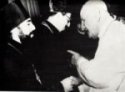

Pope John XXIII's pectoral cross decorated with Masonic symbols?
The Pope of the Council: John XXIII and Masonry
VIDEO: Masonic prayer form used in Obama inaugural luncheon invocations, including one (not shown in this video) by Catholic Priest
'Our Brothers and Sisters': Pope Benedict XVI taps Masonic prayer style in 'greetings' to Bro. Obama (use of messianic passages & imagery without specific reference to name of Jesus Christ)
Zenit: Proclaimers, Omitters, and Political Correctness
CAI: United States Catholic Catechism for Adults revised by USCCB (pdf)
CAI: Letter to Cardinal Levada on correcting error in USCCB Catechism (pdf)
Son of United Grand Lodge of England's Hereditary Grand Master married at Vatican in 2006??

Zenit: Ratzinger Foundation on Key Aspects of Pope's Theology
Zenit: Pope Worked "Subtle Revolution" in Paris
CAI: The New Religion of Karl Rahner and Joseph Ratzinger
The 'Royal Art' of Freemasonry, by Mark Stavish
The Speculative Science and the Operative Art, by Albert Mackey
Pope Benedict addresses climate change and 'the diplomatic art' with new ambassadors
Vatican II 'Gift of the Council' Watch: Diocese of Buffalo NY pleased with sales of churches
Reflection for 2nd Sunday of Advent, By Father Thomas Rosica, CSB
Karl Rahner Watch: Luise Rinswer with North Korea's Kim Il Sung
John XXIII and His Gift of the Council, By Fr. Thomas Rosica, CSB
VIDEO: The Message of Fatima
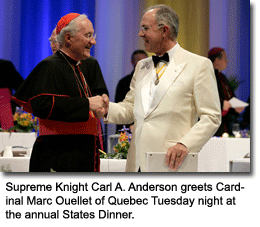
Synod: Le Plan Grande, by Marc Cardinal Ouellet
Synod: Pope says financial crisis shows money an illusion
Synod: Ten 'firsts' at the Synod of Bishops

Benedict XVI to Return to Vatican
Vatican solar panels installed
'Climate Change' on Papal Agenda for World Youth Day in Australia
VIDEO: 00:42 & 00:44
Pope to rest at Sydney Opus Dei Centre before WYD
John XXIII's Private Place & President Bush's Vatican Visit
The Saints John, Solstices & Freemasonry
U.S. News & World Report: 01:32 & 26:03

First Things: 28:19, 28:42, 29:08, 30:05, 30:11, 31:53, 33:22 & 33:33
Masters & Jesters: 43:07, 44:20 & 44:40
Pope Benedict XVI greets Christendom College and blesses cornerstone

The Book of Mathew: 'Now when Jesus was born in BETHLEHEM of Judaea'
Pics: The Story of the Broken Column
When Joseph Awoke
Ecclesiastical Literacy and Working Tools
PHOTOS: Kerry, Dodd Receive Communion at Papal Mass, Kennedy Also Receives
The Papal Visit Communion Controversy: Should Communion be given to Pro-abortion Catholic Politicians?
Bro. Giuliani breaks rules by having Communion at Papal Mass
Sebelius Issues Laughable Defense of Secret Party at Governor's Mansion Honoring Abortionist Tiller
Kansas Gov. Kathleen Sebelius attends 2008 gathering of the Bilderberg Group
Bro. Obama potential V.P. pick is most extreme pro-abortion Catholic governor
'Some Catholic': Bro. Blair participates in Fundraising Dinner for Militant Homosexual Group that has openly persecuted the Church
Mr. Bean 1 Tony Blair 0 - Labour Govt. Defeated on Bill that would have made it illegal to criticize religions or religious beliefs
Ontario Catholic Premier Bro. McGuinty supports abortion advocate's O.C.
The Terminator
VIDEO MaRS: Bro. Schwarzenegger & Bro. McGuinty Announce 'Climate Change'(Gasoline Tax Increase) & 'Cancer Research'(Stem Cell Spending) Agreement
California Education Bill Signed Into Law; 'Mom and Dad' to be replaced by 'inclusive language' in textbooks
Edward Schillebeeckx, OP & Karl Rahner, SJ
SEPA, JEANNI & ZURIGO, and BUAN
The Confession of Mr. Mikoyan
Double Eagle Press: A Practicing Catholic, a ex-Jesuit Seminarian, a American Freemason, a Clinical Psychologist
The Claim Lodge Ecclesia
The Ecclesia Lodge Claim
New Arrests by Italian Police tie Sicily Freemasonry Lodges to Mafia
St. Peter's Squared - Roberto Calvi and the P2 Masonic Lodge Conspiracy
The Roman Catholic Freemason, by Wor. Bro. ALEC MELLOR Grande Loge Nationale Francaise
On the Supreme Square Knight Blogosphere: Now you see it, now you don't...
PHOTOS: Freemasonry In Catholicism?
Vatican paper set to clear Knights Templar
Pope Benedict XVI does not wear Prada, says Vatican
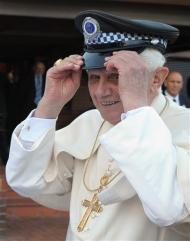
Archbishop of Sydney, Australia slams proposed carbon tax on children
UN and Planned Parenthood pushing mandatory two-child legislation in Phillipines
Further Reading:
Craftyness - Obelisks, Statutes & Plots: The 'Master' Planned Community