



 By,
Scott Lively and Kevin Abrams
By,
Scott Lively and Kevin Abrams
The story of the occult in world history is also a story of
homosexuality. By occult, we mean the formalized religious
expression of pagan culture as opposed, for example, to the
philosophical ideas of Hellenic paganism. In The Occult Roots
of Nazism, historian Nicholas Goodrick-Clarke identifies the
roots of occultism in western history:
Occultism has its basis in a religious way of thinking, the roots of which stretch back into antiquity....Its principal ingredients have been identified as Gnosticism, the Hermetic treatises on alchemy and magic [rooted in Gnosticism], Neo-Platonism, and the Cabbala....Gnosticism properly refers to the beliefs of certain heretical sects among the early Christians that claimed to possess gnosis, or special esoteric knowledge of spiritual matters....The Gnostic sects disappeared in the fourth century, but their ideas inspired the dualistic Manichaean religion of the second century (Goodrick-Clarke:17)
Since occultism is associated primarily with
Gnosticism the association of the Gnostics with homosexuality is
of primary relevance to this study. Thus, we found an obscure
reference to Hitler as a Manichaean in Steven Katz’s The
Holocaust in Historical Context, Volume 1, of interest.
Arthur Evans’ Witchcraft and the Gay Counterculture
provides some illumination here. Mani, for whom Manichaeism is
named, was a third century Prince of Babylon who devised his own
form of Gnosticism. Gnostics blended pagan sex rituals and
Mother Goddess worship with elements of New Testament
Christianity and “rejected Jehovah God as an evil
demon.” Manichaeism imposed on Gnosticism a caste system of
leaders (elect) and followers (hearers). A Manichaean sect
called the Bogomils (later called the Cathars) arose in Bulgaria
and spread across Europe. Homosexuality became so closely
associated with these Bulgarian heretics that the practice became
known as “buggery.” Indeed, “the word for
Cathar in most European languages came to be the word for
homosexual: in German, Ketzer, in Italian, Gazarro,
and in French, Herite....Heresy and homosexuality became
so interchangable that those accused of heresy attemped to prove
their innocence by claiming heterosexuality”
(Evans:51ff).
We probably all take for granted the fact that today our modern
world culture is dominated by the religions based on the Mosaic
law (i.e. Judaism, Christianity and Islam). In their orthodox
forms each of these religions regards homosexuality as an
abomination. But pagan cultures have no such prohibition. (By
definition, pagans are people who are not Jews, Christians or
Moslems). In pagan cultures, homosexuals often hold an elevated
position in religion and society. When pagan civilizations ruled
the world, homosexuality and pederasty were widely practiced and
accepted. Homosexualist author Judy Grahn
writes,
Many aspects of shamanism had homosexual content, and many of the gods, spirits, and divinities of the world have been associated with Gayness. In Tahiti there were special divinities for homosexual worship. The ancient Shinto temples of Japan display scenes of sexual ritual orgies similar to those of the Baccanalia of the Romans...the Great Mother Goddess of ancient China, Kwan-Yin, was worshipped with sexual rites that included homosexuality. When the Spanish conquistadores reached Central America and the Yucatan, they found a prevalence of Gay priests and sacred statues and stone sculpture depicting the homosexual union as a sacred act. In the Yucatan the god Chin is said to have established sacred homosexuality and a Gay priesthood serving in the temples just as was true of the temples of ancient Babylon and Sumeria (Grahn:129).
Christian writer George Grant concurs. He writes that “Rome was a perpetual satyricon. Egypt, Persia, Carthage, Babylon, and Assyria were all steeped in pederastic tradition. And the ancient empires of the Mongols, Tartars, Huns, Teutons, Celts, Incas, Aztecs, Mayans, Nubians, Mings, Canaanites, and Zulus likewise celebrated depravity, degradation and debauchery” (Grant, 1993:24). In Sexuality and Homosexuality, historian Arno Karlen writes of homosexual cults throughout the ancient world: “‘male temple prostitutes’—existed among the devotees of Ishtar and Astarte in Syria, the Albanians and Babylonians, the Canaanite neighbors of the ancient Hebrews, and in Cos, Crete and Ephesus in the Greek world” (Karlen:6).
 The ancient
religion of Baal, familiar to students of the Bible as the set of
beliefs and practices which so often corrupted Hebrew society in
history, was one such cult. Worshippers of Baal
“‘built for themselves high places and pillars, and
Asherim (phallic poles used to honor the goddess of fertility) on
every high hill and under every green tree; and there were also
male cult prostitutes in the land’” (quotation from 1
Kings 14 in Karlen:9). Reference to these practices is found in
several places in the Bible, notably Deuteronomy 23:17-18:
“There shall be no ritual harlot of the daughters of
Israel, or a perverted one of the sons of Israel. You shall not
bring the wages of a harlot or the price of a dog [male
prostitute] to the house of the LORD your God for any vowed
offering, for both of these are an abomination to the LORD your
God” (NKJ).
The ancient
religion of Baal, familiar to students of the Bible as the set of
beliefs and practices which so often corrupted Hebrew society in
history, was one such cult. Worshippers of Baal
“‘built for themselves high places and pillars, and
Asherim (phallic poles used to honor the goddess of fertility) on
every high hill and under every green tree; and there were also
male cult prostitutes in the land’” (quotation from 1
Kings 14 in Karlen:9). Reference to these practices is found in
several places in the Bible, notably Deuteronomy 23:17-18:
“There shall be no ritual harlot of the daughters of
Israel, or a perverted one of the sons of Israel. You shall not
bring the wages of a harlot or the price of a dog [male
prostitute] to the house of the LORD your God for any vowed
offering, for both of these are an abomination to the LORD your
God” (NKJ).
The Baal cult survived into Roman times and figured prominently
in the infamous debaucheries of the Roman emperors in the first
centuries after Christ. Karlen writes,
It was in association with such cults that emperors’ deviance became most flagrant. Commodus, who took the throne in 180, appeared in public dressed as a woman and was strangled by a catamitic [homosexual] favorite; Hadrian deified his homosexual lover Antious. But neither matched Elegabalus, who began his rule at the age of fourteen in 218, after having been raised in Syria as a priest of Baal. He entered Rome amid Syrian priests and eunuchs, dressed in silks, his cheeks painted scarlet and his eyes made up. Various Roman historians say that he assembled the homosexuals of Rome and addressed them garbed as a boy prostitute; put on a wig and solicited at the door of a brothel; tried to get doctors to turn him into a woman; offered himself for buggery while playing the role of Venus in a court mime; kissed his male favorites’ genitals in public and, like Nero, formally married one of them...Elegabalus erected in Rome the great phallic asherim which the Hebrew kings had kept trying to purge from their land (Karlen:62).
It is relevant to point out that this time
period in the Roman empire can be considered the
Christians’ Holocaust. In 64 A.D. Christians were blamed
by Nero for the burning of Rome and were targeted for
extermination. Many Christians suffered unimaginable tortures as
entertainment for the sadistic homosexual emperors of Rome.
Though Rome was less homosexually-oriented than Greece, Roman
society was nevertheless heavily influenced by homosexual
practices. In Homosexuality, the Torah and Grace, Dwight
Pryor reports that 14 of the first 15 Roman emperors were
homosexual (tape one). In The Construction of
Homosexuality, historian David F. Greenberg writes that
“Roman homosexual tastes were so taken for granted that
when Antony asked Herod to send his younger brother-in-law
Aristobulus to the Roman court, Herod refused because ‘he
did not think it safe to send him...to the principal man of the
Romans, and that would abuse him in his amours’”
(Greenberg:154f). While there are many differences between the
treatment of Christians in Pagan Rome and Jews in Nazi Germany,
the prominence of homosexuality among the chief perpetrators of
both atrocities cannot be ignored.
As we seek to understand Nazism, it is important to remember that
Judaism and its Christian and Islamic offshoots are fundamentally
opposed to homosexuality. As we begin to grasp the relationship
between homosexuality and occultism on one hand, and between
homosexuals and Nazism on the other, the hatred of the Nazis for
Jews and Christians may be more easily explained. The Jews were
the people responsible for the demise of pagan world domination.
Their theology (especially in its Christian form) banished pagan
practices, including homosexuality, to a hidden and often reviled
subculture. This is not to say that anti-Semitism is strictly a
result of occult or homosexual influences. But at its very root
there is a spiritual element to the Holocaust that suggests that
it was, in some respects, vengeance against the people whose
moral laws had relegated pagan sex-religions to obscurity and
ignominy.
Yet, while Christianity made great strides in limiting pagan
practices, they were not eliminated. Under Judeo-Christian
cultural pressure, surviving pagan beliefs and practices,
including sexual perversion, were forced from public life,
reemerging in secretive and mystical occultic societies.
It is important to our study that we recognize that the Nazis
were strongly influenced by pagan occult beliefs and,
additionally, that homosexuality is fundamental to many pagan
belief systems. As noted by Greenberg this is especially true in
relation to “aristocratic warrior societies”
(ibid.:111). It is also important to recognize that
homo-occultism has remained a part of pagan cultures throughout
the centuries to the present, even though the global predominance
of the Judeo-Christian sexual ethic has limited its acceptance in
most modern pagan societies such as China and Japan. When Jesuit
missionaries arrived in sixteenth century China, for example,
they found widespread pederasty (Spence:220) which they quickly
moved to erase. And Rossman compares “the
institutionalized pederasty of the privileged warrior class of
medieval Japan’s pederastic military structure” to
“Nazi society” (Rossman:23).
Greenberg reports on dozens of mostly primitive modern pagan
societies which practice ritual homosexuality, usually pederasty.
These societies are found throughout the world, including
Brazil, New Guinea, Morrocco, sub-Saharan Africa, and Malaysia.
Greenberg writes,
In many societies, male homosexual relations are structured by age or generation: the older partner takes a role defined as active or masculine; the younger, a role defined as passive or female...[In many cases] The homosexual practices are justified by the belief that a boy will not mature [without these attentions] (Greenberg:26ff).
Such modern societies are profiled in The
Sambia, by anthropologist Gilbert Herdt who studied
homosexuality in primitive cultures. He writes that “ritual
homosexuality has been reported by anthropologists in scattered
areas around the world [revealing a]...pervasive link between
ritual homosexuality and the warrior ethos....We find these
similar forms of warrior homosexuality in such diverse places as
New Guinea, the Amazon, Ancient Greece, and historical
Japan” (Herdt:203). The process of a boy’s
homosexual initiation in these societies is horrific: he is
deprived of sleep, starved, beaten and raped over several days
until he is completely “resocialized” as a homosexual
(ibid:179f).
Thus homosexuality in paganism is not a relic of antiquity but an
ongoing phenomenon. And the prevalence of homosexuals as occult
leaders continues today. In the context of Western culture this
may simply be because homosexuals gravitate to philosophies which
oppose Judeo-Christian morality. But this would not explain the
near universality of homosexual rituals in primitive and
pre-Christian pagan cultures. Homosexualist Laurence J. Rosan
writes that “the priests of these polytheistic or spirit
religions...[are] expected to be ‘different’--
unworldly, even eccentric, given to visions, dramatic
pronouncements and so on -- an ideal opportunity for both male
and female homosexuals!” (Rosan:268f). The Bible, however,
offers its own explanation, defining an individual’s
homosexuality not as an incidental factor in pagan religion but,
at least in some cases, as the consequence of “worshipping
the creation rather than the Creator.” The Book of Romans,
Chapter 1, Verses 18-27 reads as follows:
 The Operative WebMasons Guild Logo. Occultism has a strange effect on the mind... |
Ironically, the Biblical event which marks the beginning of homosexual practices in the post-flood world is the same one that is misinterpreted by pseudo-Christian white supremacists to justify their racial theories. Christian researcher Dwight Pryor gives the following interpretation (which we have summarized) of a familiar Biblical passage. In Genesis 9, Noah fell unconsious from drinking too much wine and while he was thus incapacitated Ham “saw [or uncovered] his nakedness.” This term, used primarily in the book of Leviticus, is a Hebraic euphemism for sexual intercourse. “And Noah awoke from his wine, and knew what his younger son had done to him.” As a result of his sexual attack on his father, Ham is cursed by Noah. (In Call of the Torah Rabbi Elie Munk cites Hebrew scholars who also interprets Ham’s violation as “an act of pederasty”) - (Munk:220). Thus Ham becomes Canaan, for whom the land of Canaan is named. Some generations later the Canaanite cities of Sodom and Gomorrah would be detroyed by God because of homosexuality. White supremacists refer to Ham as the father of the colored races which they call “mud people.” But it is homosexual perversion, not skin color, which is associated with the curse of Canaan.
Madame Blavatsky and the Theosphical Society
An examination of the homo-occultic influences
on the Nazis must begin with the Russian-born mystic Helena
Petrovna Blavatsky (1831-1891), founder of the Theosophical
Society and a figure who looms large behind some of the defining
actions and beliefs of the Nazi Party. Blavatsky was probably a
lesbian, but perhaps only a “latent” one. She is
described as a very “masculine” woman who dominated
her many followers, both male and female (Cavendish:250). She
was married twice and maintained a long association with
Theosophical Society co-founder Henry Olcott, but these were
relationships of convenience. Blavatsky insisted she had never
had sex with either husband (Meade:137) and wrote, “There
is nothing of the woman in me. When I was young, if a young man
had dared to speak to me of love, I would have shot him like a
dog who bit me” (ibid.:50).
A world famous occultist, Blavatsky founded the Theosophical
Society in 1875 in New York, but soon moved her operation to
India where she wrote an influential occult book called The
Secret Doctrine in 1888. In The Secret Doctrine
Blavatsky expounds the Theosophical theory of creation; a
seven-step progression of human evolution in which successive
“races” evolve from a lower to a higher form of life.
She calls these stages “root races” and identifies
our current “root race” as the fifth of seven -- the
Aryan race -- which follows the fourth race, known as the
Atlantean. Blavatsky used a variety of esoteric symbols in the
book, including triangles and swastikas. She claimed to be the
chosen spokesperson for two “exalted masters” who
communicated telepathically with her from their secret dwelling
place in Tibet (Goodrick-Clarke:18ff).
In 1884 the first German Theosophical Society was established.
Despite its ludicrous tenets, Theosophy became extremely popular
in Germany and Austria. Its Aryan racist elitism appealed to the
growing number of ethnic Germans whose voelkisch, or
nationalist, sentiments demanded a reunited Germany. According
to Blavatsky, the Aryans were the most spiritually advanced
people on earth, but the Jews had a “religion of hate and
malice toward everyone and everything outside itself.”
This was a message tailor-made for Nazism.
Before she died in 1891, Blavatsky chose her British disciple
Annie Besant to be her successor. Besant, who had once been a
devout Christian, became a dedicated occultist after meeting
Blavatsky. James Webb writes,
Mrs. Besant’s extraordinary transformations from Anglican minister’s wife through birth-control propagandist and labor leader to Theosophist ...are...well known...Arthur Nethercot, her biographer, suggests an element of the lesbian in the rapid domination of Mrs. Besant by H. P. Blavatsky (Webb:94).
“She addressed Annie in suspiciously
fulsome and endearing terms,” writes Nethercot,
“‘Dearest,’ ‘My Dearest,’
‘Dearly Beloved One,’ and signing herself ‘Very
adoring.’” Nethercot also reports that “she
dispatched missives to Annie...and addressed them to ‘My
Darling Penelope’ from ‘Your...female
Ulysses’” (Nethercot:306).
Besant’s “mentor and partner” in running the
Theosophical Society was Charles Leadbeater, whom Webb describes
as “that type of mildly homosexual clergyman who is as
familiar now as he was then” (Webb:95). But
Leadbeater’s homosexuality was not “mild”
enough to keep him out of trouble. “From his early days as
a Hampshire curate until the close of his life,” writes
Webb, “he seems to have had an incurable taste for young
men” (ibid.:95).
At one point Leadbeater claimed to have discovered the new
Messiah -- the returned Christ -- in the person of a young Indian
named Jiddu Krishnamurti. Krishnamurti gained international
acceptance among followers of Theosophy as the new Savior. The
boy’s father nearly ruined the scheme for the Theosophists,
however, when he accused Leadbeater of corrupting his son.
“There was...small doubt that Leadbeater had been up to his
old tricks again” (ibid.:102).
Under Besant and Leadbeater, Theosophy attracted an even greater
following. The writings of both Besant and Leadbeater, as well
as Blavatsky, were translated and published in Germany. An 1892
periodical, Lotus Blossoms, featured Blavatsky’s
writings and “was the first German publication to sport the
theosophical swastika upon its cover” (Goodrick-Clarke:25).
As time went on numerous other Theosophy-based occult groups
formed in Germany and Austria. Several of these groups would
provide the philosophical framework for Nazism.
Guido von List and the Armanen Order
Guido von List (1848-1919) was the first to
combine German nationalism with the occult teachings of
Theosophy. A bitter critic of Christianity, especially
Catholicism, List had converted to Wotanism (worship of Wotan,
the ancient German god of storms) as a young teenager. Years
later List “became a cult figure on the eastern edge of the
German world. He was regarded by his readers and followers as a
bearded old patriarch and a mystical nationalist guru whose
clairvoyant gaze had lifted the glorious Aryan and German past of
Austria into full view from beneath the debris of foreign
influences and Christian culture” (Goodrick-Clarke:33).
Although twice married, List was almost certainly homosexual.
His associates included Jorg Lanz von Liebenfels and Harald
Gravelle, both homosexual occultists. Gravelle, a leading
Theosophist in Germany, also contributed to the pederast journal,
Der Eigene. In 1908 List formed the Guido von List
Society in part to promote his Ariosophist research and writings,
which by this time had become viciously anti-Semitic
(ibid.:43).
List’s occult activities ranged across a wide spectrum. He
was an expert on the Rune alphabet and wrote several books on the
subject. He was particularly infatuated with the dual lightning
bolt symbol that would later become the designation for the SS.
(J. S. Jones:125). He was also a self-styled occult master,
claiming to be “the last of the Armanist magicians who had
formerly wielded authority in the old Aryan world”
(Goodrick-Clarke:33). But List was also involved in Hindu
Tantrism, a form of black magic that incorporated deviant sexual
rituals (J.S. Jones:124). As described in Cavendish’s
Man, Myth and Magic, Tantrism is a religion in which
“there are a number of rites which are regarded as
essential...group sexuality, adultery, incest and, in the higher
planes, intercourse with...demons....Perfection is gained by
satisfying all of one’s desires”
(Cavendish:2780).
In 1911, List formed an elitist occult organization called the
Hoeher Armanen-Orden (“Higher Armenen Order”). The
HAO was a hierarchical priesthood in which he was Grand Master.
List claimed this cult was the surviving remnant of an ancient
order of priest-kings called the Armanenschaft
(“Armanen Order”). This group was the source of
List’s greatest influence on the Nazis. Goodrick-Clark
writes,
List’s blueprint for a new pan-German empire [based upon a revival of the Armanenschaft] was detailed and unambiguous. It called for the ruthless subjection of non-Aryans to Aryan masters in a highly structured hierarchical state. The qualifications of candidates [for positions in the new social order]...rested solely on their racial purity...But List went further still, anticipating the mystical elitism of the SS in Nazi Germany...List’s ideal was a male order with an occult chapter (Goodrick-Clarke:64f).
Not only is List’s design strikingly
similar to the later plans of Heinrich Himmler for the
SS-controlled state, but it is also reminiscent of the
Brand/Friedlander philosophy of militaristic male supremacy.
Although the Armanen Order was never a large organization, its
membership included high-ranking members of Austrian society
(ibid.:233n). One individual in particular would turn out to be
very important to the rise of Nazism: Adolf Hitler himself.
After the fall of the Third Reich, a book written by Guido von
List was found in Hitler’s private library. On the inside
cover was written the inscription: “To Adolf Hitler, my
dear brother in Armanen,” although this is insufficient
evidence to conclude that Hitler belonged to the group (J.S.
Jones:124; Waite, 1977:90).
 Jorg Lanz von Liebenfels and
Ariosophy
Jorg Lanz von Liebenfels and
Ariosophy
If any occultist can be said to have had more
influence on Hitler and the Nazis than List it would be Jorg Lanz
von Liebenfels (1874-1954). Lanz was a former Cistercian Monk
who had been thrown out of the order “for carnal and
worldly desires” (Sklar:19). Since the Cistercian Order was
a closed, all-male monastery, it is assumed that Lanz's
indiscretions were of a homosexual nature. It was through Lanz
that Hitler would learn that many of his heroes of history were
also “practicing homosexuals” (Waite, 1977:94f).
After being expelled from the monastery, Lanz formed his own
occultic order called the Ordo Novi Templi or the Order of
the New Temple (ONT). The ONT was related to the Ordo Templi
Orientis or Order of the Temple of the East, which, like
List’s organization, practiced tantric sexual rituals
(Howard:91).
Both orders were modeled on the Teutonic Knights and the Knights
Templars, militaristic monastic orders founded in 1118 A.D. to
fight in the Crusades (Goodrick-Clarke:60). Following the
crusades, the Templars returned to Europe, but did not
demobilize. Instead its members established monasteries which
became centers of trade and influence. In the early 1300s the
Knights Templars were condemned by Pope Innocent III for
homosexual perversion and occultic practices. They were brought
to trial and disbanded by King Philip the Fair of France. Igra
writes,
[Homosexuality’s] morbid history in the German blood dates from the time of the Teutonic Knights...Their personal lives were as infamous as the more widely publicized infamies of their brother Knights, the Templars. These latter became so corrupt that they raised the practice of their cardinal vice [homosexuality] into a religious cult...There were innumerable public trials where the most revolting details were brought to light (Igra:18).
Others have confirmed the prevalence of
homosexuality among the Teutonic Knights. Adolf Brand wrote in
Der Eigene that “the Edda [Norse mythology] extols
it [homosexuality] as the highest virtue of the Teutons (Brand in
Oosterhuis and Kennedy:236f). Nazi leaders, especially Himmler,
were infatuated with the Teutons. Sklar writes that “Like
List and Lanz, Himmler was obsessed with...the Order of the
Teutonic Knights” and that he “saw his Black Guards
[the S.S.] as an elite cadre of Teutonic warriors”
(Sklar:14ff). Likewise, Hitler’s hero, Frederick the Great
“revived the vices of the Teutonic Knights” in his
army (Igra:19).
Hitler’s Ordensburgen (“Order Castles”)
were “the highest residential academies for the training of
the Nazi elite” and “received their name from the
medieval fortresses built by the Teutonic Knights”
(Snyder:261). It was fitting, then, that the swastika flag would
first be flown over one of these fortresses. On Christmas day,
1907, many years before the swastika would become the symbol of
the Third Reich, Lanz and other members of the ONT raised a
swastika flag over the castle which Lanz had purchased to house
the order (Goodrick-Clarke:109). Lanz chose the swastika, he
said, because it was the ancient pagan symbol of Wotan
(Cavendish:1983). Wotanism, incidentally, was claimed by List to
have been the national religion of the Teutons
(Goodrick-Clarke:39).
The journal of the ONT was called Ostara, named for the
female counterpart to Wotan in the pagan Germanic pantheon. Some
of the titles of Ostara pamphlets included “The
Dangers of Women’s Rights and the Necessity of a Masculine
Morality of Masters,” and “Introduction to
Sexual-Physics, or Love as Odylic Energy.” Lanz claimed
homosexuality was the result of “Odylic” influences
(Waite, 1977:93f). Lanz hated women, writing that “the
soul of the woman has something pre-human, something demonic,
something enigmatic about it” (Rhodes:108). He blamed
Aryan racial impurities on promiscuous women who were copulating
with “men of lower races.”
Lanz’s occult philosophies, which he dubbed Ariosophy
(Aryan Theosophy), were an enlargement upon the ideas of Guido
von List. To the foundation of Theosophy and German nationalism,
Lanz added the popular theme of social Darwinism, as promoted by
Ernst Haeckel and the Monist League. Haeckel is famous today for
his debunked theory that “ontogeny recapitulates
phylogeny,” the idea that the unborn young of all species
pass through distinct embryonic stages that recapitulate the
evolution of successive phyla. But in pre-Nazi Germany, Haeckel
was famous for his application of Darwin’s concept of
“survival of the fittest” to human society.
Cambridge historian and London Times journalist Ben Macintyre
writes,
The German embryologist Haeckel and his Monist League told the world, and in particular, Germany, that the whole history of nations is explicable by means of natural selection: Hitler and his twisted theories turned this pseudo-science into politics, attempting to destroy whole races in the name of racial purity and the survival of the fittest...Hitler called his book Mein Kampf, “My Struggle,” echoing Haeckel’s translation of Darwin’s phrase “the struggle for survival” (Macintyre:28f).
Ariosophy would fuel the imaginations of the Nazi elite, despite (or perhaps because of) its lunatic qualities. “Lanz fulminated,” writes Goodrick-Clarke, “against the false Christian tradition of compassion for the weak and inferior and demanded that the nation deal ruthlessly with the underprivileged” (Goodrick-Clarke:97). Waite reports that Hitler was an avid fan of Ostara and developed his anti-Semitic philosophy with the help of racist pamphlets published and distributed by Lanz and Guido von List.
[Hitler, quoted from Mein Kampf] bought some anti-Semitic pamphlets for a few pennies. These pamphlets, which were so important to the formation of Hitler’s political thinking, were distributed by a virulently anti-Semitic society called the List-Gesellschaft. The tracts were written by two now-forgotten pamphleteers, Georg Lanz von Liebenfels (1872-1954) and Guido von List (c. 1865-1919). Of all the racist pamphlets available to Hitler during those years, only those written by Lanz and List set forth in explicit detail the ideas and theories that became unmistakably and characteristically Hitler’s own. Only they preached the racial theory of history which proclaimed the holiness and uniqueness of the one creative race of Aryans; only they called for the creation of a racially pure state which would battle to the death the inferior races which threatened it from without and within; and only they demanded the political domination of a racial elite led by a quasi-religious military leader. Hitler’s political ideas were later developed and reinforced in racist circles of Munich after the war in 1919-1923, but their genesis was in Vienna under the influence of Lanz and List (Waite, 1977:91).
In 1958 Wilhelm Daim, an Austrian psychologist,
published a study of Lanz entitled Der Mann der Hitler die
Ideen gab (“The Man Who Gave Hitler His
Ideas”). In the book, Daim recounts that Lanz had met
Hitler in Vienna when the latter was 20 years old. Hitler often
visited occult bookstores and he used his contacts in some of
them to locate Lanz after having trouble finding back issues of
Ostara. While he was destitute in Vienna, Hitler
“hotly defended Liebenfels’ ideas against
skeptics” writes Snyder (Snyder:211). In 1932,
twenty-three years after that fateful meeting, Lanz wrote,
“Hitler is one of our pupils...you will one day experience
that he, and through him we, will one day be victorious and
develop a movement that makes the world tremble”
(Cavendish:1983). This proclamation, however, did not sit well
with der Fuehrer, and he had Lanz’s writings banned
in 1933 (Snyder:211).
Lanz’s Ostara was a focal point of racist and occult
figures in Germany. In Ostara,Lanz proposed that
“unsatisfactory” racial types be eliminated by
abortion, sterilization, starvation, forced labor and other
means. He also recommended Aryan breeding farms where a master
race, destined to control the world, could be hatched
(Cavendish:1983). Heinrich Himmler would later create such a
breeding program (called Lebensborn) during the Third
Reich. The close similarity of Lanz’s prescription for the
elimination of “inferiors” to the views of Benedict
Friedlander suggests the possibility of a relationship between
The ONT (Order of the New Temple) and the Community of the Elite.
One link was Harald Gravelle, a homosexual member of the Guido
von List Society who wrote for both Ostara and Der
Eigene (Steakley:67n.34). Gravelle was “the principle
theosophist of Lanz’s acquaintance, with the exception of
Guido List” (Goodrick-Clarke:100).
Although not directly connected to the ONT, the astrologist, Dr.
Karl Gunther Heimsoth was another link between the Community of
the Elite and the occultists. Heimsoth, a homosexual friend of
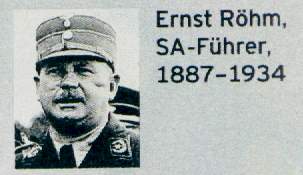
Ernst Roehm, was an early Nazi. He wrote a book titled
Charakter Konstellation, which was devoted entirely
to the horoscopes of homosexuals (Rector:81); he was also a
contributor to Der Eigene. Heimsoth is remembered for
coining the term “homophile” (Oosterhuis and
Kennedy:188), which remains a common American synonym for
homosexual.
The Thule Society

Obtuse masonic occult sex-magic humor. Note the third sale item, number c: two ball and cane surrounded by two ball and chain. The secret password of a master mason, the third degree, is Tubal Cain... |
The Feme [Vheme] was often directed against
former comrades of post-Free Corps organizations. The very
multiplicity of Bunds and secret societies led to competition,
quarreling and death....Competition and conflict was intensified
by the fact that many of the Freebooters were homosexuals and
hence prone to jealousy and “lover’s quarrels.”
The Mayer-Hermann case will serve as an example.
Oberleutnant Mayer was Kreisleiter of the
“Arbeitsgemeinschaft Rossbach.” He was also, as court
testimony euphemistically put it, “an enemy of
women,” as was his Leader, Gerhard Rossbach and, supported
by a wealthy tobacconist, one Kurt Hermann, he founded his own
“Arbeitsgemeinschaft Mayer.” But Oberleutnant Mayer
soon became jealous of a certain Gebauer, a former Baltic
fighter, who was also courting Herr Hermann. Mayer charged
Gebauer with treason and sent two of his men to Hermann’s
home. They found the traitor in bed with Herr Hermann -- Frau
Hermann was away at the time -- and carried out the sentence of
the Feme (Waite 1969:222f).
In 1917, because of the association of the Germanen Order with political terrorism, its Bavarian chapter changed its name to the Thule Society “to spare it the attentions of socialist and pro-Republican elements” (ibid.:144). The Thule Society retained many of the bizarre occult theories originated by Blavatsky and “had close ties to Crowley’s organization” (Raschke:339). Historian Wulf Schwarzwaller writes,
Briefly, the creed of the Thule Society inner circle was as follows: Thule was a legendary island in the Far North, similar to Atlantis, supposedly the center of a lost, high level civilization. But not all secrets of that civilization had been completely wiped out. Those that remained were being guarded by ancient, highly intelligent beings...The truly initiated could establish contact with these beings...[who could] endow the initiated with supernatural strength and energy. With the help of these energies of Thule, the goal of the initiated was to create a new race of supermen of “Aryan” stock who would exterminate all “inferior” races (Schwarzwaller:66f).
 The leader of the Thule Society was a man named
Rudolf von Sebottendorf but its chief organizer was Walter
Nauhaus, a former member of the Wandervoegel movement
(Goodrick-Clarke:143). Members of the Thule Society who figure
prominently in the rise of Nazism included Hans Kahnert, Dietrich
Eckart and Rudolf Hess. In 1919 Kahnert founded Germany’s
largest “gay rights” organization, the Bund fuer
Menschenrecht (“Society for Human Rights”) which
counted SA Chief Ernst Roehm among its members (J. Katz:632n94).
Eckart, meanwhile, was a founding member of the German
Worker’s Party and became Adolf Hitler’s mentor
(Shirer:65). Like Hitler, Eckart was a subscriber to
Ostara (J. S. Jones:301n91).
The leader of the Thule Society was a man named
Rudolf von Sebottendorf but its chief organizer was Walter
Nauhaus, a former member of the Wandervoegel movement
(Goodrick-Clarke:143). Members of the Thule Society who figure
prominently in the rise of Nazism included Hans Kahnert, Dietrich
Eckart and Rudolf Hess. In 1919 Kahnert founded Germany’s
largest “gay rights” organization, the Bund fuer
Menschenrecht (“Society for Human Rights”) which
counted SA Chief Ernst Roehm among its members (J. Katz:632n94).
Eckart, meanwhile, was a founding member of the German
Worker’s Party and became Adolf Hitler’s mentor
(Shirer:65). Like Hitler, Eckart was a subscriber to
Ostara (J. S. Jones:301n91).
Eckart is said by some to have been involved in Tantric occult
sex rituals “similar to Crowley’s,” and even to
have initiated Hitler into such activities (Raschke:399). While
the reliability of the original source for this information has
been questioned, perversion of this type would be consistent in
the profile of someone to whom Hitler had chosen to be close --
as we will see later when we examine Hitler’s life in more
detail. We do know that Eckart was one of the most enthusiastic
followers of Otto Weininger, a leading homosexual supremacist
whose theories denigrated women (Igra:100). There is no question
at all that Eckart was instrumental in Hitler’s early
successes. “With Eckart as his mentor,” writes
Schwarzwaller, “the gauche and inhibited Hitler -- the
unsuccessful painter, former PFC, who had not even been promoted
to corporal because of ‘lack of leadership
qualities,’ quite suddenly...became an outstanding
organizer and propagandist” (Schwarzwaller:68).
Like Roehm and Lanz, Eckart claimed credit for
“creating” Hitler. In 1923, shortly before his
death, Eckart wrote to a friend, “Follow Hitler! He will
dance, but it will be to my tune. We have given him the means to
maintain contact with them (meaning the “masters”).
Don’t grieve for me for I have influenced history more
than any other German” (ibid.:69). Though he would later
ridicule many of the occultists and their ideas, Hitler dedicated
his book, Mein Kampf, to Eckart, and at one time
called Eckart his “John the Baptiser” (ibid.:70).
The Thule Society member who would rise the highest in Nazi
circles, however, was Rudolf Hess (Toland:124). Hess, a
homosexual who was one of Hitler’s closest friends,
eventually became the Deputy Fuehrer of the Nazi Party.
Both Hess and Alfred Rosenberg had “an immence influence on
Hitler to whom they preached the gospel of the Thule
Society” (Angebert:172). In addition to his involvement
with the Thule Society, Hess belonged to yet another offshoot of
the Theosophical cult. It was an organization called the
Anthroposophical Society, formed in 1912 by Rudolf Steiner.
Steiner was a former leader of the German Theosophical Society
who split with the group following their “discovery”
of the new “messiah.” Hess was also a firm believer
in astrology (Howe:152).
Eckart and Hess were not the only members of the Thule Society
who influenced Hitler. Waite writes,
In describing his initiation into politics at Munich in 1919, Hitler stressed the importance of a little pamphlet entitled “My Political Awakening” ...[written by] a sickly fanatic called Anton Drexler...Drexler was an adjunct member of the Thule Society, the most influential of the many racist anti-Semitic groups spawned in Munich during the immediate postwar period...By the time of the revolution of 1918, the society numbered some 1500 members in Bavaria and included many of Hitler’s later supporters. Hitler himself, it is reported “was often a guest of the Society”...The actual German Worker’s Party — which was to become the mighty Nazi movement...differed very little from the discussion groups and activities of the Thule Society or the other racist groups to which all the founders belonged. (Waite, 1977:115).
 Yet another prominent Nazi who
was strongly influenced by the German occult movement was
Heinrich Himmler. Himmler maintained a close relationship with a
prominent occultist named Karl Maria Wiligut, who became known as
the “Rasputin of Himmler” (Goodrick-Clarke:177). It
is not clear if this designation is meant to imply that Wiligut
shared the infamous Russian’s penchant for sexual
licentiousness. Wiligut claimed to have a gift of clairvoyant
“ancestral memory,” certainly quite useful to the
racial purists of the Nazi Party who were concerned with proving
their own Aryan heritage. Wiligut was responsible for designing
the Death’s Head ring worn by members of the SS.
Yet another prominent Nazi who
was strongly influenced by the German occult movement was
Heinrich Himmler. Himmler maintained a close relationship with a
prominent occultist named Karl Maria Wiligut, who became known as
the “Rasputin of Himmler” (Goodrick-Clarke:177). It
is not clear if this designation is meant to imply that Wiligut
shared the infamous Russian’s penchant for sexual
licentiousness. Wiligut claimed to have a gift of clairvoyant
“ancestral memory,” certainly quite useful to the
racial purists of the Nazi Party who were concerned with proving
their own Aryan heritage. Wiligut was responsible for designing
the Death’s Head ring worn by members of the SS.
Under Himmler, the SS became a veritable occultic order.
Christian names of SS soldiers were replaced with Teutonic
names, and all members were required to maintain the strictest
secrecy and detachment from the rest of society (Sklar:100). In
later years Himmler spent vast sums of money on esoteric research
projects such as an expedition to Tibet “to look for traces
of a pure Germanic race which might have been able to keep intact
the ancient Nordic mysteries” (ibid.:102).
Himmler may well have been a homosexual (two sources are cited
later in the book), however, his intense obsession with secrecy
largely shielded him from disclosure of his private life. He
did, however, foster the cult of the mannerbund among his
men. Some report that SS special forces training required
recruits to soap each other’s bodies during showers to
establish mutual dependency (Reisman, 1994:3). Later, Himmler
would make empty threats against homosexuals in public
pronouncements, but it is clear that he was completely
comfortable being part of Adolf Hitler’s clique of
pederasts.
In any case, we can see that the occult roots of the Nazi Party
ran deep into German history. We can also see that many of the
leading occult figures responsible for this legacy were
homosexuals. From ancient pagan roots, through Blavatsky, to
List and Lanz, and to Hitler himself, the evolution of
homo-occultism gave the Nazis their theories of an Aryan Master
Race and their justification for the vicious extermination of
“inferior” life.
Resources: Chapter Two
The Pink Swastika, by Scott Lively and Kevin Abrams
On Line @ Abiding Truth
Ministries


