

Barruel And Robison's Revelations
by, Paul Fisher
 The general public's first true insight into Freemasonry did not
come until 81 years after the Fraternity's founding, when two
books lifted the veil which so decorously had concealed the
Craft's activities, except as had been exposed earlier by the
Vatican and, occasionally, by heads of State.
The general public's first true insight into Freemasonry did not
come until 81 years after the Fraternity's founding, when two
books lifted the veil which so decorously had concealed the
Craft's activities, except as had been exposed earlier by the
Vatican and, occasionally, by heads of State.
One book was written by John Robison, a highly regarded professor of philosophy and a member of the Royal Society of Edinburg. The Scottish professor said he found Masonry on the Continent much different than he knew it in the Lodges of England. Continental Masonry, he wrote, exhibited "a strange mixture of mysticism, theosophy, cabalistic whim, real science, fanaticism and freethinking, both in religion and politics." He found, too, that although everything was expressed decently, "atheism, materialism, and discontent with civil subordination pervade the whole."
A more detailed expose of the Craft was set forth in a four-volume work by the Abbe Augusten de Barruel, a refugee from Revolutionary France , whose third volume was going to press just as Robison's book was being published.
Barruel charged that many years prior to the French Revolution, men who called themselves "philosophers," conspired against God of the Gospel, against Christianity, without distinction of worship. The grand object of the "conspiracy;" the Abbe asserted, was to overturn every altar where Christ was adored.
These philosophers, the Abbe asserted, formed the sophisters of rebellion, who joined with Freemasons-a group he characterized as having a "long history" of hatred for Christ and kings. Continuing, the French-born cleric said that from this coalition came the "Sophisters of Impiety and Anarchy," who conspired "against every religion, every government, against all civil society, and even against all property . . " This latter crowd became known as the llluminati, from which sprang the Jacobins.
Although this philosophy was believed to have been gestated in England, in reality, said the Abbe, it is "the error of every man who judges everything by the standard of his own reason, and rejects in all religious matters every authority that is not derived from the light of nature. It is the error of denying every possibility of any mystery beyond the limits of man's reason, and the discard of Revelation."
The leading "philosophers" of whom Barruel spoke were the major Encyclopedists: Voltaire, Frederick II, King of Prussia, Denis Diderot and Jean D'Alembert. These men, he asserted, "acted in concert" to destroy Christianity and, he declared, the proofs of the conspiracy are drawn from their writings.
The Abbe quoted Voltaire as saying: "I am weary of hearing people repeat that twelve men have been sufficient to establish Christianity, and I will prove that one man may suffice to overthrow it."
The French historian noted that the principal Encyclopedists had a secret language and, in that connection, he cited a letter from Voltaire to D'Alembert in which it is stated: "the vine of truth is well cultivated. Translated, the statement means: "We make amazing progress against religion."
Masonic sources, it should be noted, frequently have pointed out that most of the major actors among the Encyclopedists were Masons.
[In that regard, Robison and Barruel are cited rather extensively in the following paragraphs, in order to establish that what was attested to of Masonry in Europe in the 18th Century has been confirmed by Masonic sources as a substantially accurate representation of Freemasonry in America and Europe in the 20th Century.]
Barruel said he was invited to become a member of the lower grades of Masonry, and consented to take the first two degrees which were given to him outright and in a humorous vein.
However, the third degree ritual demanded unswerving obedience to the orders of the Grand Master, even though those orders might be contrary to the King, or any other sovereign. Despite not agreeing to so bind himself, Barruel received the degree of Master Mason
Those admitted to the first three degrees of Masonry, he explained, learn that Masonic and Christian eras do not coincide. For the Mason, the Year of Light begins at Creation, thus ante-dating Moses, the Prophets and Jesus Christ
He noted that many beliefs of Masonry are quite similar to the beliefs and practices of the Manachees, such as the "follies" of the Kabbalah and magic; indifference to all religion; the same terrible oaths; and symbols of sun, moon and stars used inside the lodges.
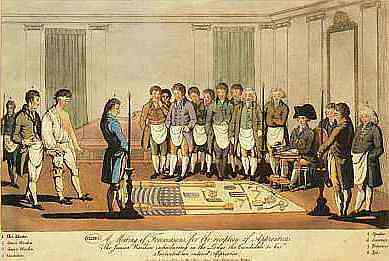
The French cleric described his own initiation and its attendant ceremonies and oaths. His accountt confirms that the Craft's degree and initiatory ceremonies of 1798 are almost identical to the Fraternity's practices today.
He said his own initiation gave him sufficient credibility to converse with those whom he know to be more advanced in Masonry, "and in many of these interviews it happened, that, notwithstanding all their secrecy, some unguarded expressions escaped the most zealous adepts, which threw light on the subject." Other Masons, he continued, lent him their books, "presuming that their obscureness and the want of essential words, or the method of discovering them, would baffle all my attempts to understand them."
With such understanding, he was able to learn the degree of Knight of the Rose Crucis, "or the Rosicrucians." The ornaments of the Lodge in that degree recall to the candidate "the solemn Mystery of Mount Calvary."
The Lodge room was draped in black with an altar prominently displayed, above which were three crosses. The middle one bore the inscription: "I.N.R.I."
"The brethren in sacerdotal vestments are seated on the ground in the most profound silence, resting their heads on their arms to represent their grief," Barruel wrote.
But, he said, it was "not the death of the Son of God, who died victim of our sins, that was the cause of their affliction." Rather, it was Christ's Crucifixion and the establishment of Christianity which moved the brethren to mourn loss of "the word, that is [their] pretended natural Religion . . . ," which dates from that sacred Day.
This was evidenced in the ceremony, the Abbe said, by the response of the Senior Warden when he is asked the time of day by the Master of the Lodge. The Warden replied:
"It is the first hour of the day, the time when the veil of the temple was rent asunder, when darkness and consternation was spread over the earth, when the light was darkened, when the implements of Masonry were broken, when the flaming star disappeared, when the cubic stone was broken, when the word was lost."
Those revelations about the Philosophy and activities of Freemasonry were no less sensational than were the disclosures of Barruel and Robison regarding the Bavarian Order of llluminati. The Order was a secret society founded by Professor Adam Weishaupt of Ingolstadt, Germany, and records show it was closely intwined with Masonry. Members of the Order, Barruel found, were the secret Masters of Masonry.
Knowledge of the Order became public during search of a house occupied by one of the leaders, as well as by conununications discovered at the Castle of Sandersdorf, a meeting place of the group. Other infortmation was made known by an unidentified spy within the Order, and by depositions given by four professors of the Marianen Academy in Bavaria, who were members of the Organization.
Weishaupt held views which, in later years, were echoed by the founding philosophers and adepts of international Conununism, as well as others. Weishaupt proclaimed:
"Liberty and Equality are the essential rights that man in his original and primitive perfection received from nature. Property struck the first blow at Equality; political society or Governments were the first dispossessors of Liberty: the supporters of Governments and Property are the religious and civil laws; therefore, to reinstate man in his primitive rights of Equality and Liberty, we must begin by destroying all Religion, all civil society and finish by the destruction of all Property."
According to Barruel, the doctrines of Illuminism came to Europe from Egypt through a Jutland merchant.
Although Weishaupt hated religion, above all the Catholic Church, he greatly admired the effectiveness of her religious orders- particularly the Jesuits-in spreading the Gospel throughout the world. "What these men have done for the altar and throne, why should I not do in opposition to the altar and throne,; the Bavarian professor remarked.
Robison, referring to testimony of the four Marianen Academy professors, said the Order of Illuminati abjured Christianity; promoted sensual pleasures; considered suicide justifiable; viewed patriotism and loyalty to country as narrow-minded prejudices incompatible with universal benevolence; held private property a hindrance to happiness; and insisted that the goals of the Order were superior to all else.
Also, he observed, members of the Order could be found only in the Lodges of Masonry.
The Edinburg scholar said members of the group "insinuated themselves into all public offices, and particularly into the courts of justice."
Weishaupt told his followers: "We must win the common people in every corner. This will be obtained chiefly by means of the schools, and by open, hearty behavior. Show condescension, popularity, and toleration of their prejudices, which we at leisure shall root out and dispel."
Continuing in the same vein, he said: "If a writer publishes anything that attracts notice, and is in itself just but does not accord with our plan, we must endeavor to win him over-or decry him."
The strength of the Order of Illuminati, he said, lies in its concealment; let it never appear in any place in its own name, but always covered by another name and another occupation. None is fitter than the three lower degrees of Freemasonry. . . .
In addition to Masonry as a cover for Illuminati activities, Weishaupt recommended that members if the Order find concealment in "a learned or literary society" which "may be a powerful engine in our hands."
He taught his followers to try to obtain influence in all offices which have any effect in "forming or in managing, or even in directing the mind of man. . . "
All members of the Order, he said, "must be assisted . . . [and] preferred to all persons otherwise of equal merit."
The organization believed that Jesus established no new religion, but only "set religion and reason in their ancient rights."
Using the arcane language of Illuminism to explain his views on social conditions and the remedy for shaping society in the Order's mold, Weishaupt, in a letter to a colleague, referred to a "rough, split, and polished stone:' The differences were explained as characterizing the rough and split stones as man's condition under civil government: "rough by ever fretting inequality of condition; and split since we are no longer one family, and are further divided by differences of government, rank, property and religion." However, when these differences are eliminated, and peoples of the world are "reunited in one family, we are represented by the polished stone."
"Examine, read, think," Weishaupt admonished his devotees as he urged them to understand symbols and symbolic language used by the Order. Explaining, he instructed his followers: "There are many things which one cannot find out without a guide, nor ever learn without instructions . . . Your Superiors . . . know the true path-but will not point it out. Enough if they assist you in every approach to it." Thus, the need for the membership at large to "examine, read, think."
The new Illuminee was "particularly recommended to study the doctrine of the ancient Gnostics and Manichaens, which may lead him to many important discoveries on the real Masonry."
The Illuminati, Robision said, hoped to use women by hinting of their "emancipation from the tyranny of public opinion."
The great aim of the Order, said the Scotch scholar, "is to make men happy," by "making them good." This was to be accomplished by "enlightening the mind, and freeing it from the dominion of superstition and prejudice."
Robison also observed that Weishaupt was firm in the conviction that the Ancient Mysteries "were useful to mankind, containing rational doctrines of natural religion." Professor Renner, one of the Marianen Academy scholars who gave a written deposition about his knowledge of the Illuminati, said the Order bound adepts by subduing their minds "with the most magnificent promises, and assure . . . the protection of great personages ready to do everything for the advancement of its members at the recommendation of the Order."
The Order enticed into its lodges only those who could be useful: "Statesmen, . . . counsellors, secretaries . . . professors, abbes, preceptors, physicians, and apothecaries are always welcome candidates to the Order."
According to a joint deposition signed by Professor Renner and his three colleagues, the object of the first degrees of Illuminism was to train the adepts in the system of espionage. Once the member had so committed himself to such nefarious acts of espionage, treason, or other treacherous enterprises, he remained in a state of perpetual dread, fearing his superiors might at some time reveal the criminal activity, the four academicians testified.
The revelations of Robison and Barruel caused a sensation, not only in Europe, but in America, and were synopsized in newspapers and recommended for reading.
On December 4, 1794, The erald of New York editorialized on the history of the French Revolution, and said that history was the history of "the Popular Societics, the principal moving springs of action during the whole revolution." The editorial urged owners of newspapers in the new nation to make the hisbry of those societies known, and recommended the works of Barruel and Robison.
Further evidence of the popularity of the works of Barruel and Robison in America was indicated when a Protestant minister, G.W. Snyder of Frederick, Maryland, sent to President George Washington a copy of Robison's book, with a covering letter,. He said the President should be familiar with many of the points made by the Scottish scholar, since Mr. Washington was himself a Mason.
The President responded by noting that he never had presided over any Masonic Lodge, and had visited such establishments very seldom. Further, he observed, he did not believe the Lodges in the United States were "contaminated" with the principles of Illuminism.
In a follow-up letter to Rev. Snyder, the President elaborated on his position and conceded that the doctrines of the Illuminism and Jacobins had indeed spread to the United States. No one, Mr. Washington said, "is more truly satisfied of this fact than I am."
Continuing, he said: " . . I did not believe that the Lodges of
Freemasons in this country had, as societies, endeavored to
propagate the diabolical tenets of the first [the Illuminati], or
the pernicious principles of the latter [Jacobins] (if they are
susceptible of separation). That individuals of them [Masonic
Lodges] may have done it, or that the founder or instrument
employed to found the Democratic Societies in the United States,
may have had these objects; and actually had a separation of the
People from their Government in view, is too evident to be
questioned."
 Excerpt
Behind the Lodge Door
Paul Fisher
Further Reading
Freemasonry in France, Belgium (E.U.), Monaco and French Africa


