


Operation Trojan
by, Col. Victor Ostrovsky and Claire Hoy

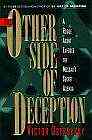 Revealing the facts as I know them from my vantage point of four years spent inside the
Mossad was by no means an easy task.
Revealing the facts as I know them from my vantage point of four years spent inside the
Mossad was by no means an easy task.
Coming from an ardent Zionist background, I had been taught that the state of Israel was incapable of misconduct. That we were the David in the unending struggle against the ever-growing Goliath. That there was no one out there to protect us but ourselves - a feeling reinforced by the Holocaust survivors who lived among us.
We, the new generation of Israelites, the resurrected nation on its own land after more than two thousand years of exile, were entrusted with the fate of the nation as a whole.
The commanders of our army were called champions, not generals. Our leaders were captains at the helm of a great ship. I was elated when I was chosen and granted the privilege to join what I considered to be the elite team of the Mossad.
But it was the twisted ideals and self-centered pragmatism that I encountered inside the Mossad, coupled with this so-called team's greed, lust, and total lack of respect for human life, that motivated me to tell this story.
It is out of love for Israel as a free and just country that I am laying my life on the line by so doing, facing up to those who took it upon themselves to turn the Zionist dream into the present-day nightmare.
The Mossad, being the intelligence body entrusted with the responsibility of plotting the course for the leaders at the helm of the nation, has betrayed that trust. Plotting on its own behalf, and for petty, self-serving reasons, it has set the nation on a collision course with all-out war.
One of the main themes of this book is Victor's belief that Mossad is out of control, that even the prime minister, although ostensibly in charge, has no real authority over its actions ...
The Mossad - believe it or not - has just 30 to 35 case officers, or katsas, operating in the world at any one time. The main reason for this extraordinary low total, as you will read in this book, is that unlike other countries, Israel can tap the significant and loyal cadre of the worldwide Jewish community outside Israel. This is done through a unique system of sayanim, volunteer Jewish helpers.
My first six weeks were uneventful. I worked at the downtown office, essentially as a gofer and filing clerk. But one chilly day in February 1984, I found myself joining 14 others on a small bus. ... This course was to be known as Cadet 16, as it was the sixteenth course of Mossad cadets.
He walked briskly to the head of the table while the other two sat at the back of the room. "My name is Aharon Sherf," he said. "I am the head of the Academy. Welcome to the Mossad. Its full name is Ha Mossad, le Modiyn ve le Tafkidim Mayuhadim [the Institute for Intelligence and Special Operations]. Our motto is: 'By way of deception, thou shalt do war.'
"It's the old Trojan dick trick." He lit a cigarette.
"What's that?" I couldn't help smiling; I'd never heard it called that before.
"I knew that would get your attention," he said, grinning. "Shimon activated Operation Trojan in February of this year."
I nodded. I'd still been in the Mossad when that order was given, and because of my naval background and acquaintance with most of the commanders in the navy, I participated in the planning for the operation as liaison with the navy.
A Trojan was a special communication device that could be planted by naval commandos deep inside enemy territory. The device would act as a relay station for misleading transmissions made by the disinformation unit in the Mossad, called LAP, and intended to be received by American and British listening stations. Originating from an IDF navy ship out at sea, the prerecorded digital transmissions could be picked up only by the Trojan. The device would then rebroadcast the transmission on another frequency, one used for official business in the enemy country, at which point the transmission would finally be picked up by American ears in Britain.
The listeners would have no doubt they had intercepted a genuine communication, hence the name Trojan, reminiscent of the mythical Trojan horse. Further, the content of the messages, once deciphered, would confirm information from other intelligence sources, namely the Mossad. The only catch was that the Trojan itself would have to be located as close as possible to the normal origin of such transmissions, because of the sophisticated methods of triangulation the Americans and others would use to verify the source.
In the particular operation Ephraim was referring to, two elite units in the military had been made responsible for the delivery of the Trojan device to the proper location. One was the Matkal reconnaissance unit and the other was Flotilla 13, the naval commandos. The commandos were charged with the task of planting the Trojan device in Tripoli, Libya.
On the night of February 17-18, two Israeli missile boats, the SAAR 4-class Moledet, armed with Harpoon and Gabriel surface-tosurface missiles, among other weaponry, and the Geula, a Hohit-class mlsslle boat with a helicopter pad and regular SAAR 4-class armament, conducted what seemed like a routine patrol of the Mediterranean, heading for the Sicilian channel and passing just outside the territorial waters of Libya. Just north of Tripoli, the warships, which were vlsible to radar both in Tripoli and on the Italian island of Lampedusa, slowed down to about four knots - just long enough to allow a team of twelve naval commandos in four wet submarines nicknamed "pigs" and two low-profiled speedboats called "birds" to disembark. The pigs could carry two commandos each and all their fighting gear.
The birds, equipped with an MG 7.62-caliber machine gun mounted over the bow and an array of antitank shoulder-carried missiles, could facilitate six commandos each, while towing the empty plgs. The birds brought the pigs as close to the shore as possible, thus cutting down the distance the pigs would have to travel on their own. (The pigs were submersible and silent but relatively slow.)
Two miles off the Libyan coast, the lights of Tripoli could be seen glistening in the southeast. Eight commandos slipped quietly into the plgs and headed for shore. The birds stayed behind at the rendezvous pomt, ready to take action should the situation arise. Once they reached the beach, the commandos left their cigarlike transporters submerged in the shallow water and headed inland, carrying a dark green Trojan cylinder six feet long and seven inches in diameter. It took two men to carry it.
A gray van was parked on the side of the road about one hundred feet from the water, on the coastal highway leading from Sabratah to Tripoli and on to Benghazi. There was hardly any traffic at that time of night. The driver of the van seemed to be repairing a flat tire. He stopped working as the team approached and opened the back doors of the van. He was a Mossad combatant. Without a word said, four of the men entered the van and headed for the city. The other four returned to the water, where they took a defensive position by the submerged pigs. Their job was to hold this position to ensure an escape route for the team now headed for the city.
At the same time, a squadron of Israeli fighters was refueling south of Crete, ready to assist. They were capable of keeping any ground forces away from the commandos, allowing them a not-soclean getaway. At this point, the small commando unit was divided into three details - its most vulnerable state. Were any of the details to run into enemy forces, they were instructed to act with extreme prejudice before the enemy turned hostile.
The van parked at the back of an apartment building on Al Jamhuriyh Street in Tripoli, less than three blocks away from the Bab al Azizia barracks that were known to house Qadhafi's headquarters and residence. By then, the men in the van had changed into civilian clothing. Two stayed with the van as lookouts and the other two helped the Mossad combatant take the cylinder to the top floor of the five-story building. The cylinder was wrapped in a carpet.
In the apartment, the top section of the cylinder was opened and a small dishlike antenna was unfolded and placed in front of the window facing north. The unit was activated, and the Trojan horse was in place.
The Mossad combatant had rented the apartment for six months and had paid the rent in advance. There was no reason for anyone except the combatant to enter the apartment. However, if someone should decide to do so, the Trojan would self-destruct, taking with it most of the upper part of the building. The three men headed back to the van and to their rendezvous with their friends on the beach.
After dropping the commandos at the beach, the combatant headed back for the city, where he would monitor the Trojan unit for the next few weeks. The commandos wasted no time and headed out to sea. They didn't want to be caught in Libyan waters at daybreak. They reached the birds and headed at full speed to a prearranged pickup coordinate, where they met with the missile boats that had brought them in.
By the end of March, the Americans were already intercepting messages broadcast by the Trojan, which was only activated during heavy communication traffic hours. Using the Trojan, the Mossad tried to make it appear that a long series of terrorist orders were being transmitted to various Libyan embassies around the world (or, as they were called by the Libyans, Peoples' Bureaus). As the Mossad had hoped, the transmissions were deciphered by the Americans and construed as ample proof that the Libyans were active sponsors of terrorism. What's more, the Americans pointed out, Mossad reports confirmed it.
The French and the Spanish, though, were not buying into the new stream of information. To them, it seemed suspicious that suddenly, out of the blue, the Libyans, who'd been extremely careful in the past, would start advertising their future actions. They also found it suspicious that in several instances Mossad reports were worded similarly to coded Libyan communications. They argued further that, had there truly been after-the-fact Libyan communications regarding the attack, then the terrorist attack on the La Belle discotheque in West Berlin on April 5 could have been prevented, since surely there would have been communications before, enabling intelligence agencies listening in to prevent It. Since the attack wasn't prevented, they reasoned that it must not be the Libyans who did it, and the "new communications" must be bogus. The French and the Spanish were right. The information was bogus, and the Mossad didn't have a clue who planted the bomb that killed one American serviceman and wounded several others. But the Mossad was tied in to many of the European terrorist organizations, and it was convinced that in the volatile atmosphere that had engulfed Europe, a bombing with an American victim was just a matter of time Heads of the Mossad were counting on the American promise to retaliate with vengeance against any country that could be proven to support terrorism. The Trojan gave the Americans the proof they needed. The Mossad also plugged into the equation Qadhafi's lunatic image and momentous declarations, which were really only meant for internal consumption.
It must be remembered that Qadhafi had marked a line in the water at that time, closing off the Gulf of Sidra as Libyan territorial waters and calling the new maritime border the line of death (an action that didn't exactly give him a moderate image). Ultimately, the Americans fell for the Mossad ploy head over heels dragging the British and the Germans somewhat reluctantly in with them. Operation Trojan was one of the Mossad's greatest successes. It brought about the air strike on Libya that President Reagan had promised - a strike that had three important consequences. First, it derailed a deal for the release of the American hostages in Lebanon, thus preserving the Hizballah (Party of God) as the number one enemy in the eyes of the West. Second, it sent a message to the entire Arab world, telling them exactly where the United States stood regarding the Arab-Israeli conflict. Third, it boosted the Mossad's image of itself, since it was they who, by ingenious sleight of hand, had prodded the United States to do what was right. It was only the French who didn't buy into the Mossad trick and were determined not to ally themselves with the aggressive American act. The French refused to allow the American bombers to fly over their territory on their way to attack Libya.
On April 14, 1986, one hundred and sixty American aircraft dropped over sixty tons of bombs on Libya. The attackers bombed Tripoli international airport, Bab al Azizia barracks, Sidi Bilal naval base, the city of Benghazi, and the Benine airfield outside Benghazi. The strike force consisted of two main bodies, one originating in England and the other from flattops in the Mediterranean. From England came twenty-four F-111s from Lakenheath, five EF-111s from Upper Heyford, and twenty-eight refueling tankers from Mildenhall and Fairford. In the attack, the air force F-111s and the EF-111s were joined by eighteen A-6 and A-7 strike and strike support aircraft, six F\A-18 fighters, fourteen EA-6B electronic jammer planes, and other support platforms. The navy planes were catapulted from the carriers Coral Sea and America. On the Libyan side, there were approximately forty civilian casualties, including Qadhafi's adopted daughter. On the American side, a pilot and his weapons officer were killed when their F-111 exploded.
After the bombing, the Hizballah broke off negotiations regarding the hostages they held in Beirut and executed three of them, including one American named Peter Kilburn. As for the French, they were rewarded for their nonparticipation in the attack by the release at the end of June of two French journalists held hostage in Beirut. (As it happened, a stray bomb hit the French embassy in Tripoli during the raid.)
Ephraim had spelled it all out for me and confirmed some of the information I'd already known. He then went on. "After the bombing of Libya, our friend Qadhafi is sure to stay out of the picture for some time. Iraq and Saddam Hussein are the next target. We're starting now to build him up as the big villain. It will take some time, but in the end, there's no doubt it'll work."
"But isn't Saddam regarded as moderate toward us, allied with Jordan, the big enemy of Iran and Syria?"
"Yes, that's why I'm opposed to this action. But that's the directive, and I must follow it. Hopefully, you and I will be done with our little operation before anything big happens. After all, we have already destroyed his nuclear facility, and we are making money by selling hlm technology and equipment through South Africa."
In the following weeks, more and more discoveries were made regarding the big gun and other elements of the Saddam war machine. The Mossad had all but saturated the intelligence field with information regarding the evil intentions of Saddam the Terrible, banking on the fact that before long, he'd have enough rope to hang himself. It was very clear what the Mossad's overall goal was. It wanted the West to do its bidding, just as the Americans had in Libya with the bombing of Qadhafi. After all, Israel didn't possess carriers and ample air power, and although it was capable of bombing a refugee camp in Tunis, that was not the same. The Mossad leaders knew that if they could make Saddam appear bad enough and a threat to the Gulf oil supply, of which he'd been the protector up to that point, then the United States and its allies would not let him get away with anything, but would take measures that would all but eliminate his army and his weapons potential, especially if they were led to believe that this might just be their last chance before he went nuclear.
Ostrovsky knows that being famous keeps him alive.
About the Author: Victor Ostrovsky was raised in Israel, but was born in Canada. At eighteen he
became the youngest officer in the Israeli military, eventually rising to the rank
of lieutenant commander in charge of naval weapons testing. He was a Mossad case
officer from 1984-1986
Further Reading:
Craftyness - Obelisks, Statutes & Plots: The 'Master' Planned Community
F.·.W.·. Magazine || 9/11: The Archive - The 'Lighter' Side of the New World Order?


